Anyone checking a US stock portfolio on the morning of Nov. 5, Thailand time, would have seen major indexes in the green after Wall Street closed Wednesday, Nov. 4, with its strongest rally in months. The Dow rose more than 3%, while the S&P 500 and Nasdaq each gained more than 1%. Look closer, though, and not every group joined in. Chip and data center stocks fell against the trend, while money poured into megacap tech names such as Apple and Microsoft, reinforcing Apple's position as the world's most valuable company.
The Dow Jumps 3% in Its Best Day Since April 2025
At the close on Nov. 4, the Dow stood at 53,356.12, up 1,569 points, or 3.03%, its best day since April 2025. The S&P 500 closed at 7,688.62, up 1.58%, and the Nasdaq at 25,736.51, up 1.44%. Drivers cited by several outlets included the market's reaction to the midterm election results, a sharp drop in oil prices and lower long-term bond yields, with energy stocks the biggest decliners as oil fell. Some market participants also pointed to optimism about a possible easing of conflict in the Middle East, which added to pressure on oil prices.
Why It Looked Red the Night Before and Green This Morning
Many investors may be confused, because the market looked worrying just a day earlier. On Tuesday, Nov. 3, Election Day, markets closed mixed, with chip stocks rebounding and the Philadelphia Semiconductor Index up 3%. But after the close, during vote counting, Nasdaq 100 futures fell more than 2% at their low on concerns about data center regulation, before markets reversed to close sharply higher on Wednesday. Thai investors watching in the morning may therefore have seen very different pictures on consecutive days: yesterday showed overnight futures falling, while this morning shows actual closing prices after the reversal.
Chip and Data Center Stocks Fall Against the Market
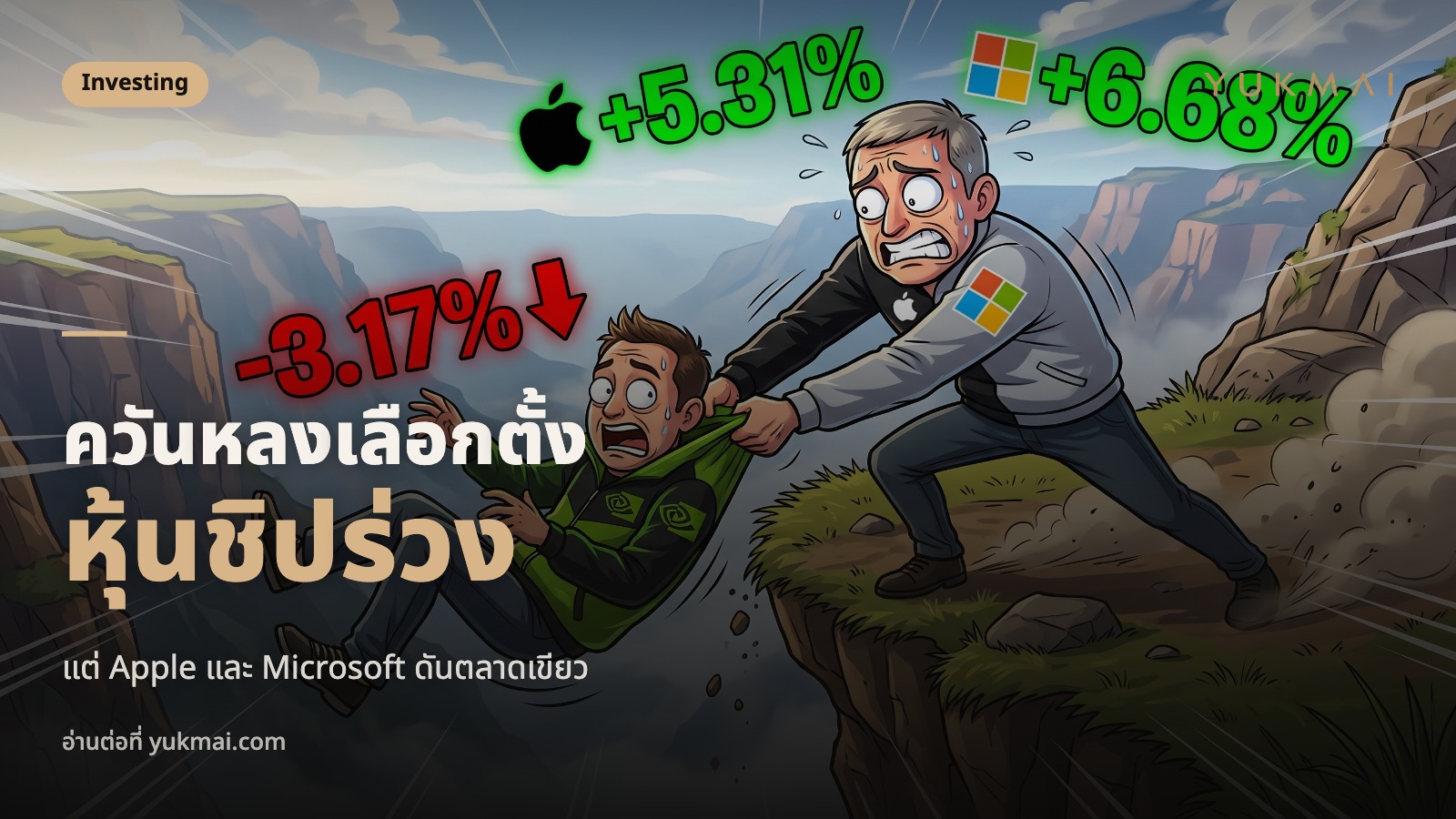
Even as major indexes rose, stocks tied to AI infrastructure were sold. Reuters reported the Philadelphia Semiconductor Index fell 3.1% the same day, Nvidia dropped about 3%, the SMH chip ETF lost about 2.8%, and South Korea's chip-heavy market fell nearly 6%. Smaller, debt-funded data center operators such as Applied Digital and Iren fell roughly 6% to 13%. The main reason was a reassessment that new data center construction could face stricter rules and permitting, hurting demand for chips and the business of new data center builders. This extends an October selloff in which names such as CoreWeave, Nebius and Iren fell at least 30%.
Money Flows Into Apple and Microsoft
Megacap tech, by contrast, saw heavy buying. Reuters reported Big Tech added roughly $750 billion in combined market value in a single day, with Apple and Microsoft up more than 5% to 6% and Amazon up about 7%. Investors reasoned that if new data centers become harder to build, companies that already control computing capacity gain an advantage and may need to spend less to compete. Many outlets framed the move as a rotation into large tech names seen as safer, away from stocks tied directly to building AI infrastructure.
Apple Overtakes Nvidia as the World's Most Valuable Company
The rally reinforced a title Apple had just regained. At the close on Oct. 30, Apple's market value was $5.03 trillion, ahead of Nvidia at $4.93 trillion, making it the world's most valuable listed company again for the first time since late July. After the Nov. 4 rally, reports put the gap wider, at roughly $5.12 trillion for Apple versus about $4.87 trillion for Nvidia. Analysts point to Apple's more restrained spending on AI infrastructure, which makes it look less risky while markets worry about massive AI capital spending. Apple shares are also up about 27% this year, nearly triple Nvidia's roughly 9.7% gain. Apple is not without risks, though: earlier this week it warned that rising memory chip costs would pressure gross margin in the holiday quarter.
What It Means for Investors: A Split Between AI Owners and AI Builders
For investors, the moves point to a sharper divide within tech. On one side are companies that already have computing capacity and customer bases, which markets see as advantaged if new data center expansion is constrained. On the other are chipmakers and data center builders that depend on continuous new investment and now face more uncertainty. The impact reaches Asia too, particularly chip-heavy markets such as South Korea and Taiwan, which Thai investors holding technology funds or chip stocks should watch. Still, a single day's move is not a long-term trend. Key things to watch are clearer post-election policy details on data centers and energy, the direction of oil prices and yields, and Nvidia's next earnings report, a major test of AI chip demand.