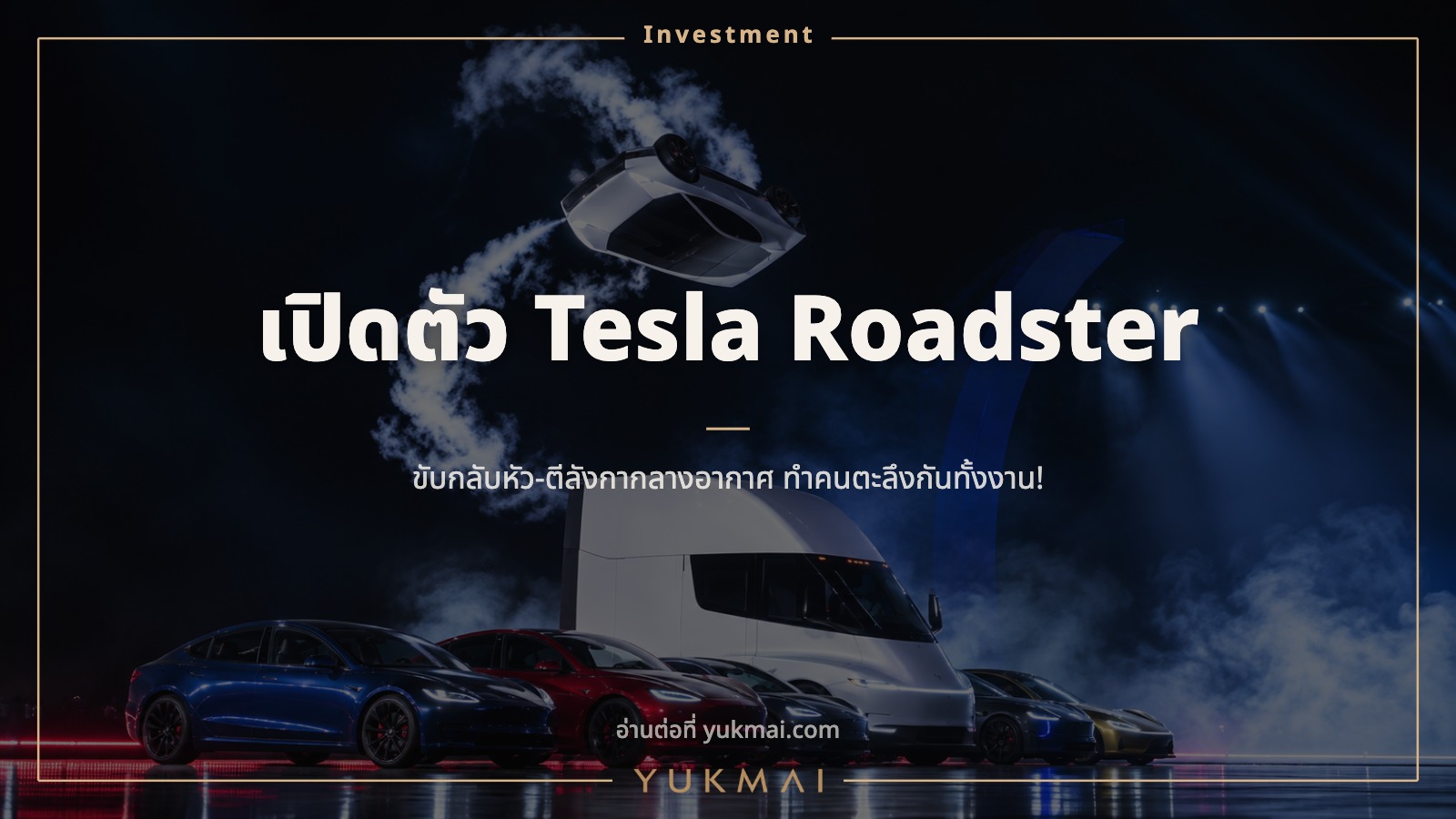
After a wait of nearly nine years, Tesla officially unveiled its new Roadster electric sports car on Thursday, Oct. 15, 2026, US time, at SpaceX's test site in McGregor, Texas. What got the internet talking was not just speed: Tesla showed the car driving upside down on a ramp, leaping over other vehicles and spinning midair before landing, using technology developed with Elon Musk's rocket company SpaceX. The event lasted under 30 minutes and focused on demonstrating the systems, while the sale price, battery size and final production specs were not disclosed. For Thai buyers, Tesla Thailand has already opened reservations on its website.
From a 2017 Prototype to a Long-Delayed Launch
The second-generation Roadster prototype was first shown in November 2017. Tesla originally planned to start production in 2020, but the schedule slipped repeatedly, and Musk now says the car will enter production in 2028. The Roadster carries big symbolic weight for Tesla: the original Roadster, sold from 2008 to 2012, was the company's first electric car and helped change how the world saw EVs. This launch event itself was pushed back from its original Oct. 1 date because of weather.
How It Drives Upside Down: Underbody Fans Generating Up to 2G
The headline feature is a suction system. The Roadster uses fans and seals under the car to pull air from beneath it, creating downforce without needing speed. Tesla says the system can generate up to 2G of suction, enough to hold the car upside down even when stationary. In Track Mode, the car lowers its ride height and adjusts its Active Aero wing to choose between more downforce or less drag, with wing actuators based on motors Tesla developed for its Optimus robot.
Flipping Midair: Cold-Gas Thrusters From SpaceX
Higher-end versions add cold-gas thrusters developed with SpaceX to boost acceleration and control the car's orientation in the air. The system uses 10 nozzles, and the car can refill its compressed-gas tanks on its own. In the demo, the Roadster climbed a ramp upside down, launched off the end, rotated midair and used thrust to help it land, then jumped over a row of parked Teslas. However, all tests were run without a driver on board to avoid safety risks, and the capability amounts to brief airborne maneuvers, not sustained flight like an aircraft. Tesla itself acknowledges the system may not be legal to use in every country.
Three Versions: Performance, Thrust and Rocket
Tesla offers three Roadster versions. Performance is a two-seat road car with the suction system and Active Aero, hitting 0-60 mph in under 1.6 seconds. Thrust is a two-seat track car that adds rear thrusters, does 0-60 in under 0.9 seconds and will be built in limited numbers. The top Rocket version is a single-seater with thrusters around the body to control vertical movement and rotation, reaching 0-60 in under 0.59 seconds with a top speed above 230 mph, and is available by invitation only; Tesla's website says it is not approved for public roads. The design moves away from the 2017 prototype toward the styling of the Cybertruck and Cybercab, inspired by the SR-71 Blackbird and F-35. Inside, it uses a yoke with steer-by-wire and lightweight materials such as magnesium, titanium and carbon fiber. All performance figures come from Tesla and have not been independently tested.
Less Range Than Promised, and Pricing Still a Mystery
Information Tesla released after the event says the new Roadster offers more than 300 miles of range per charge, less than half the roughly 620 miles Musk promised in 2017, and the company has not disclosed battery size, the range testing standard, motor output, charging time or weight. Tesla has not announced actual prices for any of the three versions, but is taking reservations with a $50,000 deposit for Performance and $250,000 for Thrust. The $200,000 starting price announced in 2017 has not been confirmed for the new car.
Unanswered Questions: Is It Legal, and Can It Really Fly?
International coverage raises several important questions. The first is legality. Asked whether the car would be street-legal, Musk replied only that it depends on your street. Tesla's website explicitly says the Rocket is not approved for public roads but says nothing about the Thrust, even though it also has rear thrusters, and Electrek noted that thruster blasts could kick road debris into other cars or pedestrians. The second is the "flying" claim: no FAA aircraft certification for the Roadster has been identified, and CNN reported it is hard to say whether the car can truly fly, since no long-range or sustained flight was shown. The third is how the specs have shifted. In 2017 Tesla promised 620 miles of range, a top speed above 250 mph, 0-60 in 1.9 seconds and four seats in a 2+2 layout, starting at $200,000. The new car offers over 300 miles, above 230 mph only on the Rocket, and two seats at most, while the sub-one-second acceleration figures come from thruster-equipped versions that may not be road-legal.
Reservations Open in Thailand: Deposits Are Not the Price
In Thailand, Tesla's website is now taking Roadster reservations. Performance requires 178,000 baht at booking and another 1,598,000 baht within 10 days, for a total deposit of 1,776,000 baht. Thrust requires 178,000 baht at booking and another 8,695,000 baht within 10 days, for a total of 8,873,000 baht. Rocket is invitation-only. Buyers should understand that these amounts are fully refundable deposits, not the car's price. Tesla has not announced Thai pricing, specifications or delivery dates, the car will be left-hand drive only, and availability depends on local regulations.
Analysts and TSLA Stock: Impressive Engineering, Unclear Business
Tesla shares closed down 1.29% on the day of the event before bouncing afterward, rising as much as 4.76% to $379.70 in premarket trading on Friday, Oct. 16. Analyst reactions, however, were cautious. Gene Munster of Deepwater Asset Management, a Tesla investor, called it an engineering flex with no commercial value beyond embarrassing traditional automakers. JPMorgan reiterated a Neutral rating with a $415 price target, noting there is no final price yet and that, with production planned for 2028, the impact on sales and profits remains unclear. Reuters noted the reveal comes as Tesla shifts its focus toward self-driving and robotics, just days before Q3 results that analysts say matter more to investors. Automotive World argued the Roadster's real product may be its SpaceX association rather than the car itself, strengthening the case for merging Musk's companies, which aligns with Barclays' view that a Tesla-SpaceX merger could be announced before December, adding to investor interest.
What It Means for Investors: A Showcase, Not a Moneymaker
Financially, the Roadster barely moves the needle for Tesla. Musk himself said in 2023 that it was not material to the company's finances, and Morningstar analyst Seth Goldstein expects Tesla to sell about 2,000 Roadsters a year, compared with roughly 1.6 million total vehicle sales last year. Still, Goldstein sees the Roadster as a new "halo car," a vehicle that showcases the brand's best engineering, something Tesla has lacked, and it reinforces the narrative of technology sharing across Musk's companies, from Tesla and SpaceX to the Optimus robot. What investors should watch is therefore not Roadster sales but Tesla's Q3 earnings after the close on Oct. 21, including automotive margins, the energy business and progress on other major projects. The open questions are whether the Roadster can deliver what was demonstrated, and whether production will start on schedule in 2028 or slip again as it has before.